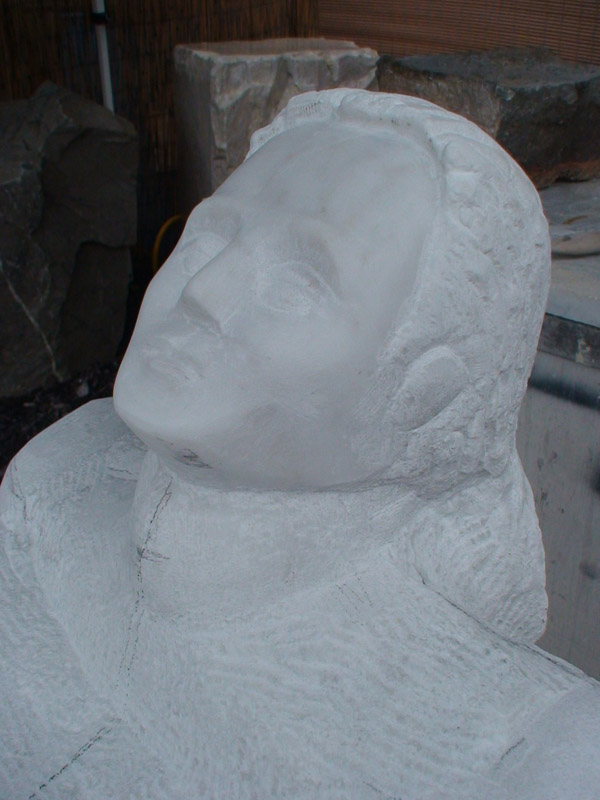
Saturday, April 14, 2012

THERE'S MARBLE IN THEM THERE ISLANDS (PART TWO)

(this blog should be read as a second part of my first blog on Alaska there will be more.)


It's been 15 years since I last visited Alaska so I may not have a exact recollection of events, however I won't let that stop me from discussing my 5-year Alaska experience.


The small part of Alaska we went to is known as South East the archipelago traveled by cruse ships,or inland passage off western Canada. Generally this area from Juneau south to Ketchikan has a climate similar to Seattle with more rain as you move north. Winters are mild but wet and can be windy and dangerous for small planes in winter as well as uncomfortable boating. Consequently I always went in the summer.


There's marble in them there islands

Mt. Calder - pure white marble


Ten percent of Alaska is owned by native corporations since statehood formation. Most of the state is federal or state owned land. It is important to know when one is looking and exploring around, whose property you are on . This is home of the Tungus, our largest national forest, now protected by President Clinton, not so when I was there. Today it would likely be illegal to walk or drive the old log roads we traveled on these remote uninhabited islands as we did, looking at geology formations.


How we get around

Old log roads

Landing craft and fishing boat home


People who live on these islands have to be self sufficient,with boats to get to town for supplies,but no infrastructure at there home site, diesel generators for power needs. Fish camps are scattered around with customers pampered in and out on float planes, getting an outback experience with no personal discomfort. Local economists gauge the economic health by calculating the ratio of pounds of fish going out, to gallons of beer coming in,on the barge transport system.


Fishing for dinner

Landing craft as truck

Dangerous passage


There is classic award winning book over 600 hundred pages describing the geology of the United States mainland, titled ANNALS OF THE FORMER WORLD by JOHN McPHEE. In it the author states that if you don’t want to read the entire book, it's enough to understand that the stone on top of Mt. Everest was formed at the bottom of the ocean. I am not smart enough to describe the geology of SE Alaska but to say that its geology was formed a long way south and smashed in, or what geologists called docked, by tectonic drift. So there is a lot of variety to look at. I found a lot of good information in the Ketchikan library on local geology, those librarians are always so kind and helpful, I hope our digital age doesn’t somehow displace them. Two of the best sources being MARBLE RESOURCES OF SOUTHEASTERN ALASKA by ERNEST F. BUCHARD, given to me by Ron Geitgey, with a section on geography and geology by THEODORE CHAPIN, bulletin 682 posted in 1920. How these guys traveled around and walked these rain forest islands is beyond my imagination. The second great source for me is a book written by PATRICIA ROPPEL, titled FORTUNES FROM THE EARTH, published in 1991. There is a lot of other great stuff on this subject but these two I found most helpful.


Me at the black deposit

Marble blocks covered with moss

Stacked and ready for San Francisco


On my first trip to SE Alaska, Bob with his meat, me with my over stuffed navy sea bag, we landed on Gravina island just off Ketchikan (bridge to nowhere fame), and took a local ferry to PRINCE OF WALES island. Then van shuttle to CRAIG our headquarters, then down to meet JIM the Alaska fisherman and explorer who lived on Bob's 42 foot wooden trawler. After going to grocery store for provisions we headed out the next morning to a friend of Jim's place, to pick up a skiff with an outboard motor to use. His friend had a wonderful home. He and his wife and one son lived in all built by him on a log raft. Behind his home he had built a large building that was his log mill all on another log raft, well lit and airy, a business he used to supplement his fishing. I remember they had a dog that he said had never been to town (had never seen another dog). I liked that.


My friend the Yakima farmer

Marble blocks

Me swimming in quarry


Shortly after heading out for Marble Island we were all engaged in conversation and came up on a concealed rock, high and dry and tilting portside. This is how navigational errors sink boats. If the tide is going out, the craft tips and fills with water . Tide was going the right for us,so we had to wait an hour or so and were lifted off and floating again. Must have hit right in the center, these old wooden fishing boats have massive keels, probably not so lucky with modern fiberglass boats. No damage, everything seemed to work again.


The black quarry

25-foot-long marble blocks under water, water left from Juneau capitol job

Rail cart in rain forest


Our fishing boat had a top speed around 6 knots, and we got to Marble Island at night fall. The solitude and stillness of this remote place is beyond description. As you approach the island two 40-foot-high stacks of quarry blocks protrude from the rain forest out into the water, all waste material abandoned there 80 to 110 years ago by the Vermont marble company. These piles of marble quarry blocks were built by loading blocks with stiff leg derricks cut from handy trees and steam driven wenches to a rail cart on top, with an improvised track to the end of the pile and dumped. By our recollection these scrap piles tangled through the rain forest for 3 miles, 40 ft wide 40 ft high, by my calculations there are probably 60,000 marble blocks resting in the rain forest. Four quarry holes of white marble and one quarry hole or black marble all filled with fresh water in the middle of a pristine rain forest. This being one of many abandoned quarries I would have a chance to visit the next five years. (MORE ON ALASKA FUN LATER )

What Makes Stone Sculpture Special?


There is  good information on the net on stone sculpture.  Most of it centers on the artist.  There is also a lot of good stuff on methods of carving.  So I don’t intend to duplicate that  work here.  I would like to describe what I believe makes stone sculpture a unique art form,  and why I bother to carve stone.

I don’t know about other areas of the country, but stone sculpture is a mystery to most people in my home, Portland Oregon  This is probably due to the fact that there is little history of stone carving in timber and basalt geography.  By my estimation,  looking at the Oregonian newspaper over the years I would estimate stone sculpture probably shows once every 800 hundred gallery opening.  It would most likely be abstract.  Consequently any one who chooses this art form would have to be quite motivated.


What we call sculpture as an art form comes in 3 popular formats.

1   assemblage - building up three-dimensional forms with metal or various materials adding or subtracting materials to suite.  Google “Cindy Dececco mig welding” for sculpture.

2    modeling -   developing  three-dimensional forms with clay.  Again adding and subtracting as needed to achieve form desired.  Then baking the clay or sending it to a foundry to use to make forms to cast in metal. 

3     sculpture  -  from the Greek word to remove, most often using wood or stone.  Not that wood or stone cant be used for assemblages as well.  But here I use the word sculpture for  subtraction only to create form.

By now you should see that these are very distinct and different art forms, only loosely related to each other.  However we most often refer to  all three of them as sculpture.     It's confusing.  Stone sculpture tends  to be the least understood and consequently the least popular and certainly the most rare of the three.

A friend of mine,  Gary McWilliams, says stone sculpture sells at about the same rate as poetry.  Well said.  I think there a lot of good reasons for this.  I will list a few here.

Because of stone sculpture's slow sales rate not many young people can afford to squander there time on it.  I certainly didn’t, to many financial responsibilities to spend time on art that has little market demand.  Consequently its entry level practitioners are for the most part no longer looking for ways to make money.  They have other motives. Anyone who knows much about the world of art understands that artists who are successful spend much of there time promoting themselves.  It is just part of the business. The starving artist who is suddenly discovered is for the most part another myth. I believe one of the reasons you don’t see much stone sculpture around is is partially due to the fact it is mostly done by a older group who don’t work very hard at self promotion. They probably sculpt stone for personal challenge and enjoy working with some thing that’s real,  in a world that tends to be quite intangible.

Stone sculpture like another unpopular art form, opera,  requires many skills.  Opera as one is taught in music appreciation studies, requires language,  music,  voice,  and acting skills.  Its complex.  Stone sculpture also requires many skills cognitive sense of proportion balance and scale, the ability to interpret the possibilities and limitations of the stone you are working on, and all technical tool skills. The learning curve can be slow,  an unpopular notion these days.


I say stone sculpture, like opera, may not be popular,  but once you are exposed to it,  it can be,  and often is,  an emotional experience.

Another problem facing the stone sculptor is that it is a difficult art form,  heavy and dirty.  Its not like the PBS bit showing a  girl with her bottom facing you holding a chisel above her head striking a beautiful block of white marble. It cant be done in a cozy studio or heated shed.  It’s an outside sport not meant for the faint hearted.  Although 50% of the sculptors I know are women,  they tend to be stout hearted and determined gals.  Google “Tom Small basalt sculpture  carving” the making of the secret language of flowers .  Stone carvers as a group are a determined bunch and do it mostly for personal challenge.


Then there is the problem of material or stone to carve.   Suitable stone is rare in the Pacific Northwest,  a basalt flooded basin.  Locating and purchasing stone can be a difficult process and a real financial barrier.  I personally have spent many summer vacations hunting for stone in southeastern Alaska,  Idaho,  Montana, and California.  Read "Marble on Edge" on Gary Williams'  Stone Arts of Alaska http://www.stoneartsofalaska.com/ web page.   I will of course have future blogs on this subject.

Tools must be sent for there is no local sculpture supply store.  Cost can be a barrier -- air compressors, saws,  hand tools, grinders,  abrasives, etc. etc. are all specialty items .  SEE Your local stone supplier for tool resources.


Location  - it's loud and messy,  neighbors won't approve of your chosen passion.  Renting a space can be expensive and difficult to find.

Finally there is the storage issue.  I suspect most sculptors keep their art in their homes.  I know two friends who keep theirs in their basement.  I find mine too heavy to carry up and down stairs so I keep mine in my shed as you can see in the video above.

It's no wonder, considering all the barriers,  that stone sculpture is so rare and misunderstood.  I think it is hard for people to have appreciation for something they have rarely seen, and have no knowledge of what it is,  or how it's done.  It is my belief, that if you grow up in a culture where stone art is rare,  you will not have much appreciation for it.  So in the future I hope to shed some light on this strange passion of mine.

Friday, April 13, 2012

The Making of My "David"


I acquired this piece of marble from Mt. Calder on Prince of Wales island in S. E. Alaska, working together with Gary Williams. I have two others left after I sold 4 or 5 to Don Wilson, a Portland based sculptor. I knew it would be the finest white marble I would ever have to work with. I did not know about its integrity since all this stone was blasted 75 years ago. So I began by hand pitching the edges, inspecting for seams and letting water dry on the surface looking for future trouble. I inspected for variations in color or mottling spots. I still had no specific idea in mind.

Back right view

It was quite flawed and pointed on top and looked narrow on back right side to do much with. I could see a seam on this side as well – that bothered me. So I cut the top, losing as little stone as possible, and removed stone to check out seam.


Front and back

I decided on David mainly because it would probably be a once-in-a-lifetime chance for me even though the right-hand side of the stone looked skimpy. I then made three sketches front left and right to help me envision the general shape and proportions. I conceived of throwing the right leg out, steeping into combat and allowing development of leg muscles, and the right arm cocked with a sling since I had enough mass there . The natural sway of the back would work to my benefit. Notice the center line front and back. It's so easy to lose your proportions in figurative art, that’s what makes it so hard to do.

At this point I decided to make a drawing of what I thought the stone could be.


I knew material was lacking and wanted as much body as the stone would give, at a decent scale that pleased me. By tilting the head up, all proportions coming from the head, allowed me maximum body size, and of course David should be looking up at the giant.
Head materializing
                       

I use proportions that use head size to determine all critical locations on the human form – a proven system that works. The widest point at David's strong shoulders was determined to be 13 inches. His face was to be a young strong man almost still a boy. Note direct sketch on side showing back shape. I wanted a twisted or curling shape suggesting body torque, ready to unravel. Right shoulder lowers, body cocked for action.


With there not being much stock on the right-hand side and a menacing seam staring at me I knew this was not going to be easy. Not many sculptors are wealthy enough to have lots of stone. Even Michelangelo's David's form was altered by lack of material. Stone sculpture is not like modeling where you just add more clay to add material. The stone sculpture is in a constant dialog with his material. Often fearful of failure, unless he is a fool.

By tilting the head I could get a six-and-one-half inch head and with cleaning up front and back of the stone I was able to lay out theoretical chin normal location giving me the breast plate at six-and-one-half inches and waist at thirteen inches . That would leave a good amount of stone for leg development. I wanted more but this would have to do in order for me to get a scale that pleased me.


Lacking confidence in my ability to carve a head made me want to do it first. If I failed at this end ever all else would be a wasted effort. I managed to get a boyish head but kept the hair long in back for strength to be removed later.


Being satisfied with the head, I undercut the neck and defined his shoulders. (Note lack of stone on the right hand side.) This dilemma made me put the lower half of right hand lower body back allowing left hand side of sculptor to charge forward providing body torque the David needed to have. It all worked out for the best as often happens with problems.

This photo shows finished sculptor body torque  


I decided to work on the right hand arm first since the seam was there, I could see how to deal with it. Getting a good sized arm here may be a challenge. I knew there was plenty of stock on the opposite side and that I would have many choices on arm and hand shape. I located the arm by pushing it back, which allowed me to cut in the back enough to get sufficient stone to cut in generous buttocks. Now for the first time, I could see that the sculpture was going to work if I continued to keep proper proportions. The left hand side could push forward leaving room for bent right arm holding a sling, ready for action.

                  
Finding arms, chest, and waist all by measurement.


Further defining back, arms, and legs.


Defining right hand arm, hand, and waist location.

Same with left arm.


It's beginning to look like art.


The basic form is completed.


It is much too heavy for me to handle, so I used our shop forklift on a Saturday, to lift with ropes, and put in a horizontal position on my work bench to carve details, hands chest, and stomach. This is a somewhat scary thing to handle. So I always do this sort of work with no one around to get hurt, trying to help. Didn’t think David would go into combat nude, so I decided to put a loin cloth attached with a line tie. This could all be textured to add interest to my David.


I wanted big hands somewhat larger than his penis, only suggested under the loin cover. I once had a art conjurer customer tell me a fireplace design I proposed to him seemed to contrived. Yes, art isn’t fluff falling from the sky, it's very contrived, thank you. I could now cut in his front legs from frontal position, pushing left hand leg forward as planned.


I carefully tipped him on his side not really knowing its balance points yet, and cut in left hand arm and sling resting on his leg.


For the first time I could stand my David up on my work bench, by leaving sufficient stone mass on bottom. This allowed me to work all around the stone at a comfortable height and align critical measurements up by measurement from work table. Both front and back could now be aligned for the first time with ease.
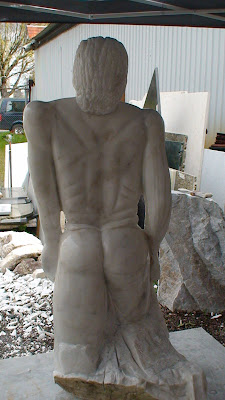


Refining details, opening arm cavities etc.


I put sculpture back down to further detail back muscles and form strong legs, then drill hole for pinning.


After weeks of sanding and detailing mostly up to 220 and sealing, since it was to stay outside, I bought the strongest line I could find and rigged it for lifting, a tricky job . It seemed to lift quite straight which sort of surprised me. I am often surprised at artists' paranoia at this point as if their sculpture was a gift to mankind. I always tell people it's only stone let it fall if necessary -- just stay out of the way.


I am glad I pinned him for he falls backward quite easy . I set him on a block of limestone I had, not a perfect perch but about the right height I think. This is something I am not very good at. I have entered my David in several public art-on-the-street proposals but it was never accepted. Figurative art is not much appreciated in this country. It has been sitting in my stone yard, remnant slab yard now for two years, has probably been seen by 500 or more Oregonians of all types. There has never been one comment since I placed it there. I think that says something, I don’t know what. I am quite sure if I put a wooden totem pole out there, crowds would gather and rave. But I am not going to.    

Addendum:
I worked on this sculpture mostly during the cold season in Portland, Oregon, outside on an average of 3 hours a day for about 2 1/2 months. The weather didn't bother me because I was excited about doing the project!