Wednesday, April 18, 2012

SOME BITS OF ADVICE GIVEN ME BY STONE PEOPLE

Being around as long as I have one has heard a lot of sage advice from stone workers.
 
When I was a 23-year-old quarry worker, john Alexander, founder of the largest granite company in the world, cold spring granite, told me a few things I never forgot but probably abused often in my life:

- Never hire an artist, always hire a mechanic.

- Never sell something you don’t have.

- Never fire someone until you have someone to replace him.

We all break this rules over and over, especially # 2.

Once when I had an open multiple wire saw available I sawed a block of black diamond granite slabs thinking I was getting ahead of things. Mr. Alexander had seen these slabs on a visit and asked what job they were for. I told him. He asked me if I would like my paycheck when they sell. I got the message quickly. I am sure he was the smartest stone man I have ever been around.

Another great stone man I had the privilege of working with Peter Rigutto. My son calls his nephew re-Pete. If Pete was still alive he would be well over 100 years old. I was a part-time marble helper, full-time G.I. Bill, 30-some college student interested in physical geography and urban studies. For five years I worked for Pete whenever he wanted me.

Pete told me he walked over the Dolomites with his dad, they slacked their own lime, doing marble work in Holland as a kid. Later as apprentice marble setter for his dad in Portland USA. He kept things going by working as a marble setter, being a professional wrestler, and playing cello in an orchestra during the depression.

Pete mostly gave his lessons in expressions but was a great ad-libber:

- Never got enough till you got too much

- Lucky to get it.

- Pearls before swine.

- Can’t make a silk purse out of sow’s ear.

Work men of his era were gruff with home owners. Not a bad policy all in all. It kept them from looking over your shoulder and second-guessing what you’re doing. He preferred to tell you when he was finished, and not have you look for problems.

I don’t know why but women loved Pete But they seemed to get under his skin. I asked him once way he always knew more about my college subject matters than me, he said he had  the advantage of Italian being his first language. Words had meaning and he never got along with his wife so he spent a lot of time at his beach shack reading.

Once after laying out a complicated slate floor in a building lobby downtown all the women got to know him and his quips after two weeks walking in and out of the building . We installed the slate ramp up to the door at quite a steep angle I thought, but one never questioned Pete’s work. The president of the bank thought to it was too steep and to be dangerous. The women chuckled, saying you just did that as they walked in. Pete responded without looking up ,women aren’t the only ones who can change their mind.

Pete was laying a marble floor in an eastern Oregon home and the lady homeowner came in and started tapping the finished areas with a pole thinking she was checking for a good job. Pete dryly said we just lay them ma’am, we don’t tune ‘em. When Pete’s brother and I got together as we often did before they died we never talked about Pete, it was too hard. Fred was no slouch himself. You can always pick these old great Italian marble men with their strong hands, never seem to be more then a foot off the ground ready to go to work laying a floor. Fred always said what you don’t get done by noon isn’t worth doing. A craftsman’s work ethic. The difference between a good job and a perfect job is a waste of time. I learned a lot from these two brothers and miss both of them all the time.

A note about Fred. Fred had a lathe in his garage and would always help you tool a special part you wanted. He was a true Italian mechanic par excellence. And Pete surely would have been an artist in another life.

Fred the mechanic would say "not much call for that" when you presented him with your latest innovation, whereas Pete would have smiled and said "keep going Joe!"
   
Mr. Alexander, the Scottish granite man, ended up owning thousands of acres of land, and had over 3000 employees working for him. The two Italian brothers ended up sharing their mother’s side lot for a garden. All three of these stone men were a great influence on my life.

I would like to finish by stating that the two Italian marble masons enjoyed and shared the food they grew, the fish they caught, and the wine they made all their lives. I am sure neither one would have traded lives with anyone, nor would the great Scottish entrepreneur trade his life. All three of them had great lives in the stone industry.

Tuesday, April 17, 2012

HOWARD, THE ONE HUNDRED THIRTY POUND MUSCLE MAN

My Delivery System


Moving stone, due to its mass, has always been a topic of conversation and interest to the general public. Pyramid construction, Stonehenge, Mayan ruins, etc. Seems to be a endless source of TV documentaries. Sculpture groups give seminars on handling large heavy stones. Working with gravity, simple levers, inclined planes, etc. Is essential to stone-loving sculptors. Today we have lifting devices of all sorts to make things easy, but it wasn't so long ago these aids were not often used.


When I was attending Portland State University in the early 1970s, I cut letters and polished monuments after classes and often delivered monuments with Howard Coleman, a five-foot-six 130-pound machine polisher. We both worked at a tombstone manufacturing shop in Portland, Oregon Howard got his start in the stone trade working in Medica Lake white granite quarry in eastern Washington, near Spokane Howard would take me along when he had monuments to install in local cemeteries around Portland and sometimes outside of the Portland area as well.


He needed no help with with flat markers 2 foot by 1 foot, or 2 foot 4 inch by 1 foot 4 inch. Or 4 foot by 1 foot double markers. Nor did he need help with hickey or slant markers, they only weighed 150 to 200 hundred pounds.


It's a special language this monument business. I taught it to my daughter and we still laugh at things like ”carnelian 3-0 x1-10x 0-8 ck molds -rock sides with 4-0x 1-0 x 8 base.” All a stone man needs to know to start working making a specific color, size, and detailed monument.


Howard cut and polished raised lettering by hand at night for extra money using hand-held emery bricks. My mentor Julius would rough out the lettering with the sandblast and Howard would take it from there, polishing square and sharp corners with lots of fine details with a flat recessed background in granite.


I spent many pleasant Fridays helping him deliver monuments in a 1947 four-speed green flatbed, equipped with split rear end for the open road to local cemeteries.


Monuments, that is die and base, went mainly to Jewish cemeteries, and occasionally to a gypsy section in one cemetery. Flat run the lawn mower over the top markers is good enough for most of us. Its all about price and cemetery efficiency and a lack of interest in the dead. In our mainstream society, no “day of the dead” ceremonies remembering our parents or grandparents north of the Rio grand.


Howard’s basic tools were planks, broom handle rollers , 4x4 cribbing, plywood for path construction, a 4-wheel balloon tire heavy-duty hand truck, and a pinch bar seldom used, it being a dangerous tool. He would deliver and install 500 to 1000 pound fragile and expensive monuments with ease. Knowing that any chips or scratches were unacceptable to the customer. He would raise them up on the base with the hand truck and put a special goop he rolled in his hand while I rocked the monument back. He slid them down off the truck on his trusty planks and moved them through the cemetery without damaging the grass with his hand truck on plywood roads he laid down.


With a guy like Howard, what company would bother with a lifting device? We both worked cheap, low wages and long hours. Fridays were often 7 to 7 by the time we got back to the shop with a lunch at one of Howard's favorite beer joints.


Early one spring – I don't remember whether it was hood river or The Dalles, Oregon – Howard asked me to go with him in the old green flatbed loaded with his trusty planks, 4x4 cribbing, 4x4 by 8 foot beams, chains and belts, come along puller, plywood road material and a solid stone altar about 8 foot long and 4 foot wide and 3 feet high, it must have weighed about 8 tons. It was to be installed in a catholic church. I didn't know how he was going to do this so I told my wife and children I would be back later in the week.


Howard had already cased the job out, for when we got to church parking lot,two auto wreckers pulled up, one one each side of the flatbed. We rigged the lifting cables, the wreckers coordinated the lift and Howard drove the flatbed out. I don't remember whether he had them lower on to a steel cart or whether it came down on his 4x4 roller system, it's been 40 years. I do remember that it took 2 days to move the altar with the come along up into the front door and down the center aisle and up to the front of the church. Turn it and and safely land this fragile and expensive stone. I assume it's still there.


Food and lodging at a motel was provided by the company we worked for. I remember when we drove back down into the Willamette Valley the heavy rich smell of spring in the air and feeling of accomplishment working with this gentle man. I learned a lot from him and a few years later when I had my own little business I had a opportunity to move and turn an altar with my companion Schmitty. I will save that story for another blog.


Whenever I go back to my home town in Minnesota I always visit the cemeteries where my brothers and sisters and parents are buried, all with beautiful upright die and base monuments, and think about my roots.


My Final Installation System

Monday, April 16, 2012

Stonecutters Provide the Human Touch

The design of a stone tabernacle for a Portland, Oregon, church was completed with a partnership of design and craftsmanshipby Joseph Conrad
Joseph Conrad Stonecutter
Portland, Oregon

(First published in Stone World magazine, April 1996)

The design of the tabernacle of the Holy Rosary Catholic Church in Portland, Oregon, was influenced by Venetian churches.


My association with the restoration of the Holy Rosary Catholic Church in Portland, Oregon, began when Father Anthony asked if I could restore and reduce the size of an historic marble altar for the church's 100-year celebration. The altar, having come from St. Mary's Cathedral in San Francisco after the 1906 earthquake, had been moved several times, and its size did not fit the space well.

After studying the way the altar was built, I knew this could be done tastefully without damaging the original design. However, I was somewhat intimidated by his request that I propose a design for a tabernacle to stand behind the altar. I eventually proposed that a marble tabernacle could be built utilizing an existing insert in the altar. The new tabernacle would reflect the design elements of the altar.

As a second-generation stonecutter with 35 years in the stone industry, I admit to a prejudice favoring local stone fabrication in spite of economic and social realities favoring foreign manufacturing of stone products. However, I am convinced that many experienced craftsmen intuitively view three-dimensional forms from a practical perspective which I call "Inside-Out Design," which was utilized for this project.

Inside-Out Design is the perception of physical forms as a series of processes that generate form. The architectural designer looks at the physical, social and economic needs of the client and proceeds to define a physical form to fulfill those needs. The craftsman looks at the same needs of the clients, asks how much money he has to spend, surveys the tools and supplies he has to work with, and proceeds to define the form.

In Practice

As we dissembled the altar to bring it to our fabrication shop for refurbishing, Father Anthony gave me some 1940 photos of the original tabernacle. He reminded me that tabernacles and church statuary and furniture are typically purchased in Italy, but there was a change in Church policy directing the use of local craftsmen whenever possible.

While this was refreshing news, I assume this proclamation is more typically interpreted to buy materials in Italy as usual and have local labor move it in. However, Father Anthony was determined to employ local craftsmen and artisans for the entire process.

He contacted Michael Dante, a professor of sculpture at the University of Oregon, to design and build the ornate sculptured doors for the tabernacle. Two separate sets of doors were required to house and show the monstrance at different elevations for religious ceremonies. Consequently, sizes were roughly established in human scale. The metal container and interior lighting were to be enclosed by a marble structure.

Father Anthony then hired DiBenedetto/Thomson Architects of Portland to design the structure. The architectural design team studied Venetian churches and developed drawings for a stone tabernacle.
A meeting to review the plans was held, including members of the architectural design team, the sculptor, Father Anthony, the church historian, myself and others. Each of us provided input as to the feasibility of construction and design concepts. It was decided that while the tabernacle should be the center of focus for the church, it should not overwhelm the space only with size. We wanted it to function on a human scale while also relating to the altar in front of it. As a sculptor, Dante was also concerned with door function, texture and relief.

Father Anthony requested that the architectural firm develop a full-size mock-up and set it in the space to check for scale, introduce and get input from congregational members, the donor and fellow church clergy.

After assembling the Styrofoam mock-up, it was decided to downsize the structure. Certain modifications were made, working drawings were given to me, and Dante was instructed to start on the doors.

Father Anthony and I then went to a local stone supply yard, Oregon Tile & Marble, to select material for the project. We set aside three slabs of Carrara White and chose accent and column stones later as the colors of the church decor evolved.

The construction procedure

Any complex stone project must start the same way, with full size drawings that include: plan, front, left, right, rear and critical sections through. Full-size drawings ensure that all parts work together. For example, if the doors swing into the column base, modifications would be required to make it work. It is useful to make drawings on pattern board. If kept clean and dry, they can then act as templates to build from as the project takes shape.

The stone craftsman must turn a single dimension drawing (flat plane) into a three-dimensional form. Often, changes in design occur during the process. As few people are capable of truly perceiving three-dimensional objects from shop drawings, patterns help.

The tabernacle was viewed as separate understandable stone components.


The tabernacle was viewed a separate understandable stone components, and shop tickets were made describing each element. At this point, shop experience is critical to create three-dimensional forms with little seam appearance. Understanding of shop machinery and practices are critical, as well as having strong knowledge of the stone's characteristics.

For some of the features, the various elements were cut-to-size, the edges detailed and the pieces were then assembled and glued to form a whole component. The components were then dry set in our shop and viewed by Father Anthony and the designer. Following the procedure, minor adjustments to the lighting were made.

Once approved, the assembly of the tabernacle at the church took less than six hours.


Once approved, the assembly of the tabernacle at the church took less than six hours. The local fabrication in this case allowed the customer/builder to interact with the artisans involved in the project. Sophisticated customers often require the stamp of craftsmen, which provides some of the soul that can be lost in day-to-day life.

Sunday, April 15, 2012

THERE'S MARBLE IN THEM THERE ISLANDS (PART ONE)


A piece of pure white marble from Mount Calder, Southeast Alaska. Native corporations have sold millions of dollars of this material to Japan for paper whitening and other chemical uses, including (probably) indigestion tablets!


Black marble from a small quarry next to five large white quarries abandoned on Marble Island, Alaska (around 1925).


Two small mill blocks sitting next to my truck in SE Portland. We sent these blocks to New Mexico Travertine to be cut into slabs.

Thirty-five years ago I rented a small quonset hut in southeast Portland's low-rent district and attempted my first effort at my own stone business as a 35 year old. I was totally impoverished with a wife and two children and no work. This was pre-granite counter days, the stone business didn't exist. Outside tombstones, or an occasional fireplace facing. Stone tiles were first beginning to appear. There was some question whether these stone tiles were work for marble masons or tile setters. In an attached shed next to mine worked Schmitty, a 70-year-old man who cast cement collars around flat tombstones for cemeteries. We became friends.

Schmitty told me that during the depression he raised and trapped for furs in the southeast Alaska islands. He told me that there was a machine shop on an island that he could use to repair his outboard motor left by a marble quarrying operation. Apparently a caretaker was still assigned to this operation by the Vermont marble company. This was when I first heard of marble in southeast Alaska. I never thought much about it until 15 years later I received a phone call from an Alaskan fisherman. He told me he got my name from a maritime attorney in Portland suggesting me as a stone expert. Thus began a five-year misadventure with Alaska marble.

The fisherman to the best of my recollection was fishery biologist who retreated from a government fisheries post for seclusion in southeast Alaska to create his own private reality, which he seemed to prefer. This sort of behavior seems to be not uncommon in southeast Alaska, rugged individualists. He had all the skills to function in a world of what seemed to me to be a severe and dangerous profession. We became phone companions with daily conversations. He told me about marble blocks on an island, and that he had an offer to provide slabs from this stone for a courthouse remodel in eastern Washington. In the next several months I talked him through the steps to remove these blocks for his courthouse dream.

About 4 months later he showed up at the front door of my small stone fabrication shop in Portland and told me he had gone to a competitor stone company and they had no idea what to do with the stone blocks he had on the back of this old beat-up flatbed truck, and again asked for help. We went for breakfast where he informed me he hated cities and particularly restaurants with their fake flower arrangements. He also expressed a dislike for people in general and that he had lost 35 pounds breaking the stone and getting it on his boat and eventually down to Portland on this flatbed . I later found that his food preferences were lukewarm sausages, instant coffee and cigarettes, which seemed to sustain this 6-foot-5 inch healthy man. It could have ended right there if I said go away but I didn't. This was before the internet, information was hard to get so I decided to help him.

I went back to my shop and called a friend of mine who owned and operated one of only two stone saw shops west of the Mississippi, that could saw his blocks, Ted Orchard. Ted, a true professional, a hero of mine agreed to help him. The fisherman was off and running, glad to get away from town. I was told he slept under his truck for the week it took to slab his blocks.

Six months later the fisherman called me out of the blue and told me he delivered the slabs to the courthouse, got paid, and wanted to try this marble business again. I was flabbergasted and asked why I should help him. He asked if I would meet his partner, a Yakima farmer at the Alaska air terminal in Seattle, and they would show me Alaska. How could I say no?

Thus began one of the greatest friendships of my life with a 70-year-old farmer who got his degree in chemistry before World War II.

I packed my old Navy seabag with what I thought might be appropriate gear for life on a fishing boat and found Bob. He was hard to miss in his coveralls, and small hand bag. Pulling two white styrofoam coolers taped up, filled, I learned later, with Bob's own home-cured without any refrigeration that is, beef. Quite crusty. A process all new to me. This aged beef was to be a special treat for the fisherman even though he had no way to properly cook it. I found out later. Bob the ever-harvesting farmer wanted the cooler to be filled with fish he intended to sell when we got back from our trip to Alaska. Bob's mind was not on marble, although he was curious to learn. Bob's interest, besides shrimp and salmon, was looking for a good spot to raise oysters, the salinity of fresh and salt water and location was someplace in southeast Alaska. The whole experience was all new to me, the marble man.

Bob was a practical man, he would just as soon provide sandwiches hot coffee and cash to native fishermen for resale then to harvest them himself on fish openings. My friend Bob loved to say cash is still legal tender. The fisherman's favorite expression I later learned was nothing final till Lisbon, the U.S. Not having an extradition treaty with Portugal. He had big dreams about the value of marble. Bob and I were off to Alaska – me with my overpacked seabag, him with his Yakima meat, which later turned out to remind me of another Joseph Conrad's meat supply, getting larger and smellier as they traveled upstream one hundred years earlier.

View of #1 stone mill blocks stacked on 6 x 6s waiting for shipment by ocean transport to San Francisco - but they never left! (Marble Island, Alaska)


Saturday, April 14, 2012

THERE'S MARBLE IN THEM THERE ISLANDS (PART TWO)

(this blog should be read as a second part of my first blog on Alaska there will be more.)


It's been 15 years since I last visited Alaska so I may not have a exact recollection of events, however I won't let that stop me from discussing my 5-year Alaska experience.


The small part of Alaska we went to is known as South East the archipelago traveled by cruse ships,or inland passage off western Canada. Generally this area from Juneau south to Ketchikan has a climate similar to Seattle with more rain as you move north. Winters are mild but wet and can be windy and dangerous for small planes in winter as well as uncomfortable boating. Consequently I always went in the summer.


There's marble in them there islands

Mt. Calder - pure white marble


Ten percent of Alaska is owned by native corporations since statehood formation. Most of the state is federal or state owned land. It is important to know when one is looking and exploring around, whose property you are on . This is home of the Tungus, our largest national forest, now protected by President Clinton, not so when I was there. Today it would likely be illegal to walk or drive the old log roads we traveled on these remote uninhabited islands as we did, looking at geology formations.


How we get around

Old log roads

Landing craft and fishing boat home


People who live on these islands have to be self sufficient,with boats to get to town for supplies,but no infrastructure at there home site, diesel generators for power needs. Fish camps are scattered around with customers pampered in and out on float planes, getting an outback experience with no personal discomfort. Local economists gauge the economic health by calculating the ratio of pounds of fish going out, to gallons of beer coming in,on the barge transport system.


Fishing for dinner

Landing craft as truck

Dangerous passage


There is classic award winning book over 600 hundred pages describing the geology of the United States mainland, titled ANNALS OF THE FORMER WORLD by JOHN McPHEE. In it the author states that if you don’t want to read the entire book, it's enough to understand that the stone on top of Mt. Everest was formed at the bottom of the ocean. I am not smart enough to describe the geology of SE Alaska but to say that its geology was formed a long way south and smashed in, or what geologists called docked, by tectonic drift. So there is a lot of variety to look at. I found a lot of good information in the Ketchikan library on local geology, those librarians are always so kind and helpful, I hope our digital age doesn’t somehow displace them. Two of the best sources being MARBLE RESOURCES OF SOUTHEASTERN ALASKA by ERNEST F. BUCHARD, given to me by Ron Geitgey, with a section on geography and geology by THEODORE CHAPIN, bulletin 682 posted in 1920. How these guys traveled around and walked these rain forest islands is beyond my imagination. The second great source for me is a book written by PATRICIA ROPPEL, titled FORTUNES FROM THE EARTH, published in 1991. There is a lot of other great stuff on this subject but these two I found most helpful.


Me at the black deposit

Marble blocks covered with moss

Stacked and ready for San Francisco


On my first trip to SE Alaska, Bob with his meat, me with my over stuffed navy sea bag, we landed on Gravina island just off Ketchikan (bridge to nowhere fame), and took a local ferry to PRINCE OF WALES island. Then van shuttle to CRAIG our headquarters, then down to meet JIM the Alaska fisherman and explorer who lived on Bob's 42 foot wooden trawler. After going to grocery store for provisions we headed out the next morning to a friend of Jim's place, to pick up a skiff with an outboard motor to use. His friend had a wonderful home. He and his wife and one son lived in all built by him on a log raft. Behind his home he had built a large building that was his log mill all on another log raft, well lit and airy, a business he used to supplement his fishing. I remember they had a dog that he said had never been to town (had never seen another dog). I liked that.


My friend the Yakima farmer

Marble blocks

Me swimming in quarry


Shortly after heading out for Marble Island we were all engaged in conversation and came up on a concealed rock, high and dry and tilting portside. This is how navigational errors sink boats. If the tide is going out, the craft tips and fills with water . Tide was going the right for us,so we had to wait an hour or so and were lifted off and floating again. Must have hit right in the center, these old wooden fishing boats have massive keels, probably not so lucky with modern fiberglass boats. No damage, everything seemed to work again.


The black quarry

25-foot-long marble blocks under water, water left from Juneau capitol job

Rail cart in rain forest


Our fishing boat had a top speed around 6 knots, and we got to Marble Island at night fall. The solitude and stillness of this remote place is beyond description. As you approach the island two 40-foot-high stacks of quarry blocks protrude from the rain forest out into the water, all waste material abandoned there 80 to 110 years ago by the Vermont marble company. These piles of marble quarry blocks were built by loading blocks with stiff leg derricks cut from handy trees and steam driven wenches to a rail cart on top, with an improvised track to the end of the pile and dumped. By our recollection these scrap piles tangled through the rain forest for 3 miles, 40 ft wide 40 ft high, by my calculations there are probably 60,000 marble blocks resting in the rain forest. Four quarry holes of white marble and one quarry hole or black marble all filled with fresh water in the middle of a pristine rain forest. This being one of many abandoned quarries I would have a chance to visit the next five years. (MORE ON ALASKA FUN LATER )

What Makes Stone Sculpture Special?


There is  good information on the net on stone sculpture.  Most of it centers on the artist.  There is also a lot of good stuff on methods of carving.  So I don’t intend to duplicate that  work here.  I would like to describe what I believe makes stone sculpture a unique art form,  and why I bother to carve stone.

I don’t know about other areas of the country, but stone sculpture is a mystery to most people in my home, Portland Oregon  This is probably due to the fact that there is little history of stone carving in timber and basalt geography.  By my estimation,  looking at the Oregonian newspaper over the years I would estimate stone sculpture probably shows once every 800 hundred gallery opening.  It would most likely be abstract.  Consequently any one who chooses this art form would have to be quite motivated.


What we call sculpture as an art form comes in 3 popular formats.

1   assemblage - building up three-dimensional forms with metal or various materials adding or subtracting materials to suite.  Google “Cindy Dececco mig welding” for sculpture.

2    modeling -   developing  three-dimensional forms with clay.  Again adding and subtracting as needed to achieve form desired.  Then baking the clay or sending it to a foundry to use to make forms to cast in metal. 

3     sculpture  -  from the Greek word to remove, most often using wood or stone.  Not that wood or stone cant be used for assemblages as well.  But here I use the word sculpture for  subtraction only to create form.

By now you should see that these are very distinct and different art forms, only loosely related to each other.  However we most often refer to  all three of them as sculpture.     It's confusing.  Stone sculpture tends  to be the least understood and consequently the least popular and certainly the most rare of the three.

A friend of mine,  Gary McWilliams, says stone sculpture sells at about the same rate as poetry.  Well said.  I think there a lot of good reasons for this.  I will list a few here.

Because of stone sculpture's slow sales rate not many young people can afford to squander there time on it.  I certainly didn’t, to many financial responsibilities to spend time on art that has little market demand.  Consequently its entry level practitioners are for the most part no longer looking for ways to make money.  They have other motives. Anyone who knows much about the world of art understands that artists who are successful spend much of there time promoting themselves.  It is just part of the business. The starving artist who is suddenly discovered is for the most part another myth. I believe one of the reasons you don’t see much stone sculpture around is is partially due to the fact it is mostly done by a older group who don’t work very hard at self promotion. They probably sculpt stone for personal challenge and enjoy working with some thing that’s real,  in a world that tends to be quite intangible.

Stone sculpture like another unpopular art form, opera,  requires many skills.  Opera as one is taught in music appreciation studies, requires language,  music,  voice,  and acting skills.  Its complex.  Stone sculpture also requires many skills cognitive sense of proportion balance and scale, the ability to interpret the possibilities and limitations of the stone you are working on, and all technical tool skills. The learning curve can be slow,  an unpopular notion these days.


I say stone sculpture, like opera, may not be popular,  but once you are exposed to it,  it can be,  and often is,  an emotional experience.

Another problem facing the stone sculptor is that it is a difficult art form,  heavy and dirty.  Its not like the PBS bit showing a  girl with her bottom facing you holding a chisel above her head striking a beautiful block of white marble. It cant be done in a cozy studio or heated shed.  It’s an outside sport not meant for the faint hearted.  Although 50% of the sculptors I know are women,  they tend to be stout hearted and determined gals.  Google “Tom Small basalt sculpture  carving” the making of the secret language of flowers .  Stone carvers as a group are a determined bunch and do it mostly for personal challenge.


Then there is the problem of material or stone to carve.   Suitable stone is rare in the Pacific Northwest,  a basalt flooded basin.  Locating and purchasing stone can be a difficult process and a real financial barrier.  I personally have spent many summer vacations hunting for stone in southeastern Alaska,  Idaho,  Montana, and California.  Read "Marble on Edge" on Gary Williams'  Stone Arts of Alaska http://www.stoneartsofalaska.com/ web page.   I will of course have future blogs on this subject.

Tools must be sent for there is no local sculpture supply store.  Cost can be a barrier -- air compressors, saws,  hand tools, grinders,  abrasives, etc. etc. are all specialty items .  SEE Your local stone supplier for tool resources.


Location  - it's loud and messy,  neighbors won't approve of your chosen passion.  Renting a space can be expensive and difficult to find.

Finally there is the storage issue.  I suspect most sculptors keep their art in their homes.  I know two friends who keep theirs in their basement.  I find mine too heavy to carry up and down stairs so I keep mine in my shed as you can see in the video above.

It's no wonder, considering all the barriers,  that stone sculpture is so rare and misunderstood.  I think it is hard for people to have appreciation for something they have rarely seen, and have no knowledge of what it is,  or how it's done.  It is my belief, that if you grow up in a culture where stone art is rare,  you will not have much appreciation for it.  So in the future I hope to shed some light on this strange passion of mine.

Friday, April 13, 2012

The Making of My "David"


I acquired this piece of marble from Mt. Calder on Prince of Wales island in S. E. Alaska, working together with Gary Williams. I have two others left after I sold 4 or 5 to Don Wilson, a Portland based sculptor. I knew it would be the finest white marble I would ever have to work with. I did not know about its integrity since all this stone was blasted 75 years ago. So I began by hand pitching the edges, inspecting for seams and letting water dry on the surface looking for future trouble. I inspected for variations in color or mottling spots. I still had no specific idea in mind.

Back right view

It was quite flawed and pointed on top and looked narrow on back right side to do much with. I could see a seam on this side as well – that bothered me. So I cut the top, losing as little stone as possible, and removed stone to check out seam.


Front and back

I decided on David mainly because it would probably be a once-in-a-lifetime chance for me even though the right-hand side of the stone looked skimpy. I then made three sketches front left and right to help me envision the general shape and proportions. I conceived of throwing the right leg out, steeping into combat and allowing development of leg muscles, and the right arm cocked with a sling since I had enough mass there . The natural sway of the back would work to my benefit. Notice the center line front and back. It's so easy to lose your proportions in figurative art, that’s what makes it so hard to do.

At this point I decided to make a drawing of what I thought the stone could be.


I knew material was lacking and wanted as much body as the stone would give, at a decent scale that pleased me. By tilting the head up, all proportions coming from the head, allowed me maximum body size, and of course David should be looking up at the giant.
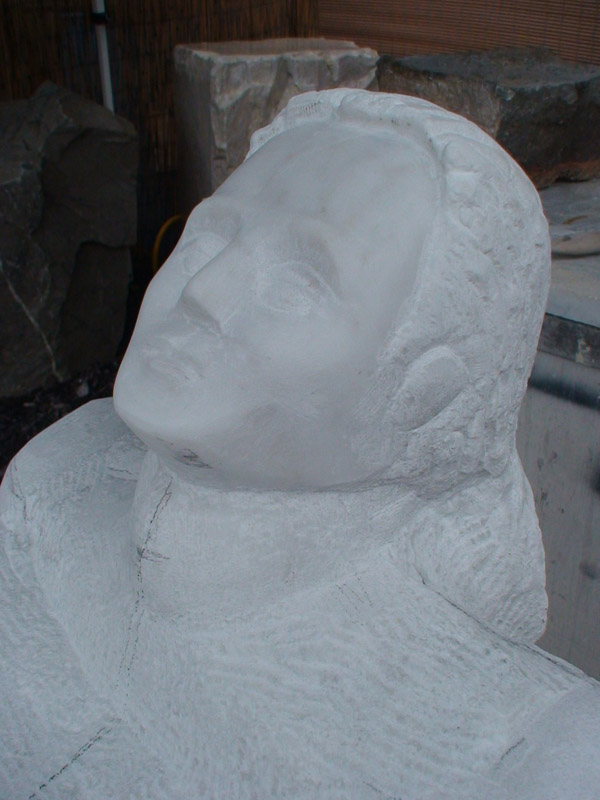
Head materializing
                       

I use proportions that use head size to determine all critical locations on the human form – a proven system that works. The widest point at David's strong shoulders was determined to be 13 inches. His face was to be a young strong man almost still a boy. Note direct sketch on side showing back shape. I wanted a twisted or curling shape suggesting body torque, ready to unravel. Right shoulder lowers, body cocked for action.


With there not being much stock on the right-hand side and a menacing seam staring at me I knew this was not going to be easy. Not many sculptors are wealthy enough to have lots of stone. Even Michelangelo's David's form was altered by lack of material. Stone sculpture is not like modeling where you just add more clay to add material. The stone sculpture is in a constant dialog with his material. Often fearful of failure, unless he is a fool.

By tilting the head I could get a six-and-one-half inch head and with cleaning up front and back of the stone I was able to lay out theoretical chin normal location giving me the breast plate at six-and-one-half inches and waist at thirteen inches . That would leave a good amount of stone for leg development. I wanted more but this would have to do in order for me to get a scale that pleased me.


Lacking confidence in my ability to carve a head made me want to do it first. If I failed at this end ever all else would be a wasted effort. I managed to get a boyish head but kept the hair long in back for strength to be removed later.


Being satisfied with the head, I undercut the neck and defined his shoulders. (Note lack of stone on the right hand side.) This dilemma made me put the lower half of right hand lower body back allowing left hand side of sculptor to charge forward providing body torque the David needed to have. It all worked out for the best as often happens with problems.

This photo shows finished sculptor body torque  


I decided to work on the right hand arm first since the seam was there, I could see how to deal with it. Getting a good sized arm here may be a challenge. I knew there was plenty of stock on the opposite side and that I would have many choices on arm and hand shape. I located the arm by pushing it back, which allowed me to cut in the back enough to get sufficient stone to cut in generous buttocks. Now for the first time, I could see that the sculpture was going to work if I continued to keep proper proportions. The left hand side could push forward leaving room for bent right arm holding a sling, ready for action.

                  
Finding arms, chest, and waist all by measurement.


Further defining back, arms, and legs.


Defining right hand arm, hand, and waist location.

Same with left arm.


It's beginning to look like art.


The basic form is completed.


It is much too heavy for me to handle, so I used our shop forklift on a Saturday, to lift with ropes, and put in a horizontal position on my work bench to carve details, hands chest, and stomach. This is a somewhat scary thing to handle. So I always do this sort of work with no one around to get hurt, trying to help. Didn’t think David would go into combat nude, so I decided to put a loin cloth attached with a line tie. This could all be textured to add interest to my David.


I wanted big hands somewhat larger than his penis, only suggested under the loin cover. I once had a art conjurer customer tell me a fireplace design I proposed to him seemed to contrived. Yes, art isn’t fluff falling from the sky, it's very contrived, thank you. I could now cut in his front legs from frontal position, pushing left hand leg forward as planned.


I carefully tipped him on his side not really knowing its balance points yet, and cut in left hand arm and sling resting on his leg.


For the first time I could stand my David up on my work bench, by leaving sufficient stone mass on bottom. This allowed me to work all around the stone at a comfortable height and align critical measurements up by measurement from work table. Both front and back could now be aligned for the first time with ease.


Refining details, opening arm cavities etc.


I put sculpture back down to further detail back muscles and form strong legs, then drill hole for pinning.


After weeks of sanding and detailing mostly up to 220 and sealing, since it was to stay outside, I bought the strongest line I could find and rigged it for lifting, a tricky job . It seemed to lift quite straight which sort of surprised me. I am often surprised at artists' paranoia at this point as if their sculpture was a gift to mankind. I always tell people it's only stone let it fall if necessary -- just stay out of the way.


I am glad I pinned him for he falls backward quite easy . I set him on a block of limestone I had, not a perfect perch but about the right height I think. This is something I am not very good at. I have entered my David in several public art-on-the-street proposals but it was never accepted. Figurative art is not much appreciated in this country. It has been sitting in my stone yard, remnant slab yard now for two years, has probably been seen by 500 or more Oregonians of all types. There has never been one comment since I placed it there. I think that says something, I don’t know what. I am quite sure if I put a wooden totem pole out there, crowds would gather and rave. But I am not going to.    

Addendum:
I worked on this sculpture mostly during the cold season in Portland, Oregon, outside on an average of 3 hours a day for about 2 1/2 months. The weather didn't bother me because I was excited about doing the project!